
Prices
-
Washington Post: Working Americans are using less health care, but spending more
 Read more: Washington Post: Working Americans are using less health care, but spending more
By: Carolyn Johnson Americans who get health insurance through their jobs are not using more medical care than they were five years ago, but they are spending more due to soaring medical prices, according to a new report. Health spending for the more than 150 million people who receive insurance through their employers was $5,407…
-
Advisory Board: ED visits down – but ED facility fee spending is up, Vox analysis suggests
Read more: Advisory Board: ED visits down – but ED facility fee spending is up, Vox analysis suggestsSpending on emergency department (ED) facility fees rose steadily between 2009 and 2015, even as the overall number of ED fees billed declined, according to an analysis of Health Care Cost Institute (HCCI) data, Sarah Kliff writes for Vox. However, the American College of Emergency Physicians (ACEP) is pushing back against the findings, noting that…
-
ER spending increased 85%, driven by price increases for the most severe cases (2009-2015)
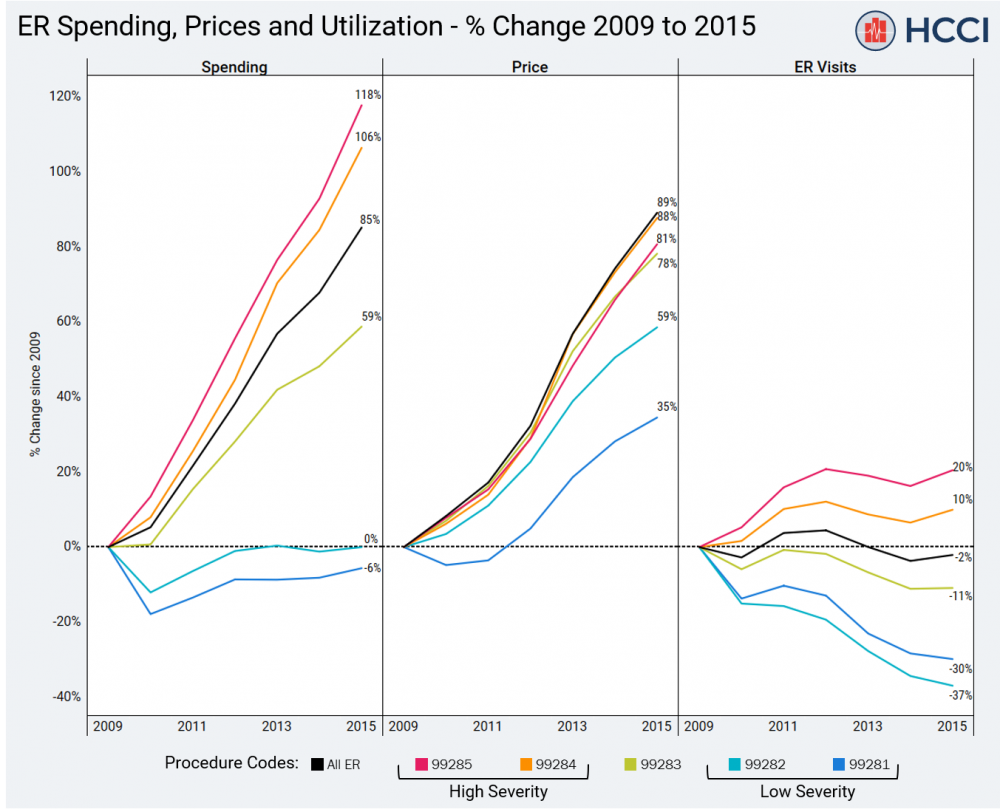 Read more: ER spending increased 85%, driven by price increases for the most severe cases (2009-2015)
Medical bills from the Emergency Room (ER) are a mystery to many patients in the US health system. From incredibly high, varying charges to surprise bills resulting from in/out of network confusion, many Americans have no idea what to expect when it comes to the cost of this necessary service. Recently, Vox reporter, Sarah Kliff,…
-
Price of insulin prescription doubled between 2012 and 2016
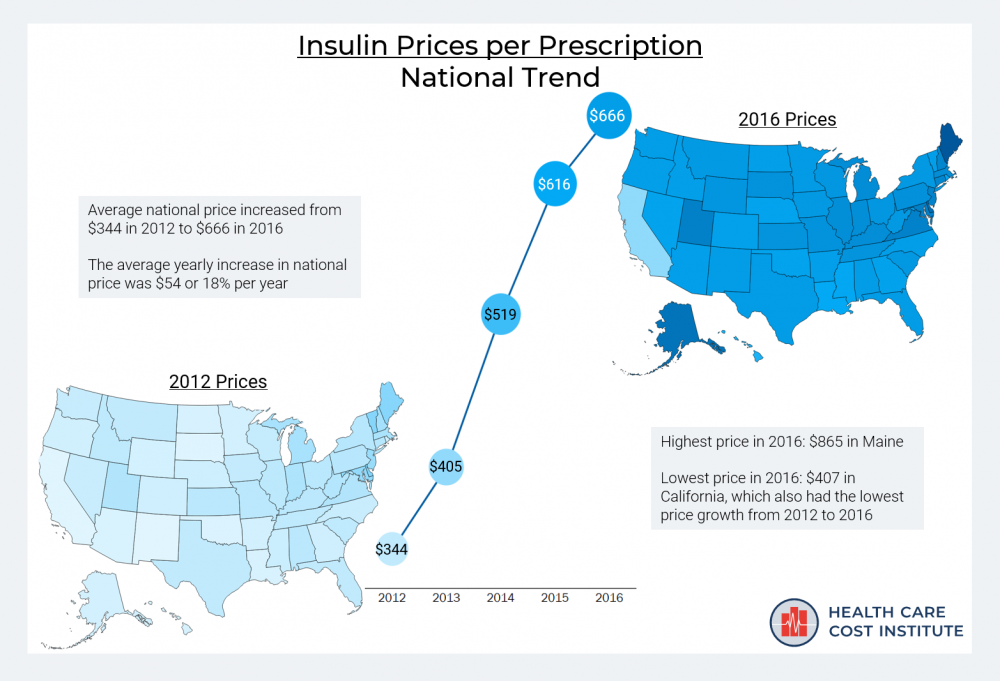 Read more: Price of insulin prescription doubled between 2012 and 2016
In honor of National Diabetes Month, our inaugural blog post focuses on a topic of particular interest to people with diabetes: the price of insulin. Insulin is the hormone responsible for the body’s ability to use sugar and prevent dangerously high and potentially deadly levels of blood sugar. Diabetics are unable to make enough insulin…
-
ProPublica: A Hospital Charged $1,877 to Pierce a 5-Year-Old’s Ears. This Is Why Health Care Costs So Much.
Read more: ProPublica: A Hospital Charged $1,877 to Pierce a 5-Year-Old’s Ears. This Is Why Health Care Costs So Much.By: Marshall Allen This story was co-published with NPR’s Shots blog. Two years ago, Margaret O’Neill brought her 5-year-old daughter to Children’s Hospital Colorado because the band of tissue that connected her tongue to the floor of her mouth was too tight. The condition, literally called being “tongue-tied,” made it hard for the girl to…
-
Modern Healthcare: Q&A with Brennan – “You are going to have more of an interest in what services actually cost”
Read more: Modern Healthcare: Q&A with Brennan – “You are going to have more of an interest in what services actually cost”Three months ago, Niall Brennan was appointed president and executive director of the Health Care Cost Institute, a not-for-profit organization based in Washington, D.C., that focuses on improving price transparency through the use of insurance data. He succeeds David Newman, a health policy expert who had led the organization since its founding in 2011. Brennan…
-
NBER: Does Multispecialty Practice Enhance Physician Market Power?
Read more: NBER: Does Multispecialty Practice Enhance Physician Market Power?ABSTRACT: In markets for health services, vertical integration – common ownership of producers of complementary services – may have both pro- and anti-competitive effects. Despite this, no empirical research has examined the consequences of multispecialty physician practice – a common and increasing form of vertical integration – for physician prices. We use data on 40 million…
-
New York Times: Medicare Advantage Spends Less on Care, So Why Is It Costing So Much?
Read more: New York Times: Medicare Advantage Spends Less on Care, So Why Is It Costing So Much?By: Austin Frakt The Medicare Advantage program was supposed to save taxpayers money by allowing insurers to offer older Americans private alternatives to Medicare. The plans now cover 19 million people, a third of all those who qualify for Medicare. Enrollee satisfaction is generally high, and studies show that plans offer higher quality than traditional…
-
Health Affairs: Medicare Competitive Bidding Program Realized Price Savings For Durable Medical Equipment Purchases
Read more: Health Affairs: Medicare Competitive Bidding Program Realized Price Savings For Durable Medical Equipment PurchasesABSTRACT: From the inception of the Medicare program there have been questions regarding whether and how to pay for durable medical equipment, prosthetics, orthotics, and supplies. In 2011 the Centers for Medicare and Medicaid Services (CMS) implemented a competitive bidding program to reduce spending on durable medical equipment and similar items. Previously, CMS had used…
-
Health Affairs: Reference Pricing Changes the ‘Choice Architecture’ of Health Care for Consumers
Read more: Health Affairs: Reference Pricing Changes the ‘Choice Architecture’ of Health Care for ConsumersABSTRACT: Reference pricing in health insurance creates incentives for patients to select for nonemergency services providers that charge relatively low prices and still offer high quality of care. It changes the “choice architecture” by offering standard coverage if the patient chooses cost-effective providers but requires considerable consumer cost sharing if more expensive alternatives are selected….