
Inpatient Spending
-
Non-Shoppable Health Care Services: Inpatient Hospitalizations
 Read more: Non-Shoppable Health Care Services: Inpatient Hospitalizations
This data brief reports on spending and utilization in populations likely unable to shop for a hospital prior to seeking care, comparing spending and length-of-stay for individuals who were admitted through the emergency department (ED) to that of individuals who needed ambulance services the day of their admission through the ED.
-
JAMA Internal Medicine: A Perspective on Out-of-Pocket Spending
Read more: JAMA Internal Medicine: A Perspective on Out-of-Pocket SpendingTo the Editor Understanding out-of-pocket spending is critical to understanding health care costs in the United States. We applaud the efforts of Adrion et al as an important contribution to understanding the out-of-pocket spending of the commercially insured population younger than 65 years. The commercially insured comprise over 50% of the nonelderly US population and, as…
-
Medicare Advantage Health Care Utilization – Observation Stays
Read more: Medicare Advantage Health Care Utilization – Observation StaysThis data brief reports on outpatient observations stays in the Medicare Advantage population from 2010 through 2014. The results show that the rate of observations stays increased in total as well as following hospitalizations.
-
2015 Health Care Cost and Utilization Report
Tags: Commercially Insured, Drug Spending, HCCUR, Inpatient Spending, Outpatient Spending, Physician Spending, Utilization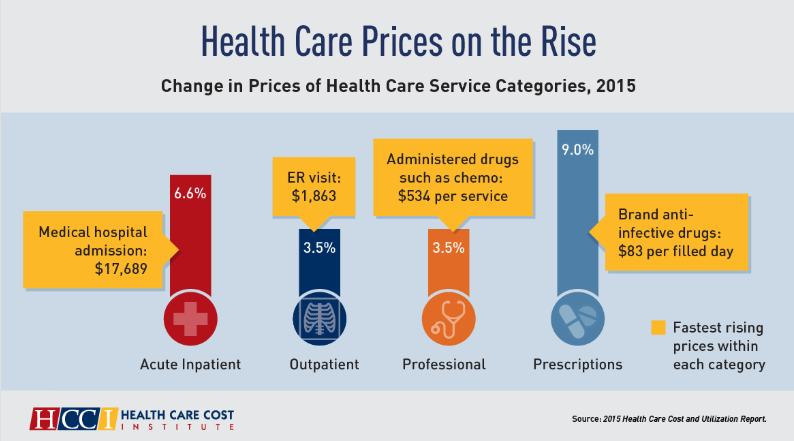 Read more: 2015 Health Care Cost and Utilization Report
The 2015 Health Care Cost and Utilization Report shows that spending per privately insured averaged $5,141 in 2015, up $226 from the year before. Key Findings Health care spending averaged $5,141 per individual in 2015, up $226 from the year before. Out-of-pocket spending rose 3.0 percent in 2015, to an average of $813 per capita….
-
Medicare Advantage Health Care Utilization – Hospital Readmissions
Read more: Medicare Advantage Health Care Utilization – Hospital ReadmissionsThis data brief, reports on five readmission rate measures for the Medicare Advantage (MA) population: 30-day all-cause hospital-wide readmissions and 30-day all-cause readmissions following acute myocardial infarction (AMI), heart failure, chronic obstructive pulmonary disease (COPD), and pneumonia. The results show that MA readmission rates have been declining over the past five years.
-
NBER: Why Don’t Commercial Health Plans Use Prospective Payment?
Tags: Commercially Insured, Geographic Variation, Inpatient Spending, Market Concentration, NBER, Peer Reviewed JournalsRead more: NBER: Why Don’t Commercial Health Plans Use Prospective Payment?ABSTRACT One of the key terms in contracts between hospitals and insurers is how the parties apportion the financial risk of treating unexpectedly costly patients. “Prospective” payment contracts give hospitals a lump-sum amount, depending on the medical condition of the patient, with limited adjustment for the level of services provided. We use data from the…
-
JAMA Internal Medicine: Out-of-Pocket Spending for Hospitalizations Among Nonelderly Adults
Read more: JAMA Internal Medicine: Out-of-Pocket Spending for Hospitalizations Among Nonelderly AdultsABSTRACT Importance: Patients’ out-of-pocket spending for major health care expenses, such as inpatient care, may result in substantial financial distress. Limited contemporary data exist on out-of-pocket spending among nonelderly adults. Objectives: To evaluate out-of-pocket spending associated with hospitalizations and to assess how this spending varied over time and by patient characteristics, region, and type of…
-
Health Affairs: Medicare Advantage Plans Pay Hospitals Less Than Traditional Medicare Pays
Tags: Commercially Insured, Health Affairs, Inpatient Spending, Medicare, Medicare Advantage, Outpatient Spending, Peer Reviewed JournalsRead more: Health Affairs: Medicare Advantage Plans Pay Hospitals Less Than Traditional Medicare PaysABSTRACT There is ongoing debate about how prices paid to providers by Medicare Advantage plans compare to prices paid by fee-for-service Medicare. We used data from Medicare and the Health Care Cost Institute to identify the prices paid for hospital services by fee-for-service (FFS) Medicare, Medicare Advantage plans, and commercial insurers in 2009 and 2012….
-
2014 Health Care Cost and Utilization Report
Tags: Commercially Insured, Drug Spending, HCCUR, Inpatient Spending, Out-of-Pocket, Outpatient Spending, Physician SpendingRead more: 2014 Health Care Cost and Utilization ReportThe 2014 Health Care Cost and Utilization Report tracks changes in health care prices, utilization, and spending for people younger than 65 covered by employer-sponsored health insurance (ESI). The 2014 Health Care Cost and Utilization Report shows that spending per privately insured person grew 3.4% in 2014, with more dollars going to brand-name drugs than…
-
Children’s Health Spending: 2010-2013
Read more: Children’s Health Spending: 2010-2013Children’s Health Spending: 2010–2013 shows that spending on healthcare for children (ages 0-18) covered by employer-sponsored insurance grew an average of 5.7% per year. The increase in spending in 2013 occurred despite a drop in the use of prescription drugs and visits to the emergency room, demonstrating that rising health care prices were an evident…