
Health Affairs
-
Health Affairs: Surprise Billing: Choose Patients Over Profit
 Read more: Health Affairs: Surprise Billing: Choose Patients Over Profit
HCCI’s research on median in-network rates was recently featured in a Health Affairs blog post on surprise billing. From the blog: “Most importantly, Congress should establish a locally based benchmark to determine the amount an insurer would be required to pay a provider for a surprise bill. Ideally, we’d set the benchmark at some multiple…
-
Health Affairs: Variation In Health Spending Growth For The Privately Insured From 2007 to 2014
Read more: Health Affairs: Variation In Health Spending Growth For The Privately Insured From 2007 to 2014ABSTRACT We examined the growth in health spending on people with employer-sponsored private insurance in the period 2007–14. Our analysis relied on information from the Health Care Cost Institute data set, which includes insurance claims from Aetna, Humana, and UnitedHealthcare. In the study period private health spending per enrollee grew 16.9 percent, while growth in…
-
Health Affairs: Medicare Advantage And Commercial Prices For Mental Health Services
Tags: Commercially Insured, Health Affairs, Medicare Advantage, Mental Health and Substance Use, Peer Reviewed JournalsRead more: Health Affairs: Medicare Advantage And Commercial Prices For Mental Health ServicesAbstract: In 2014, insurers paid an average of 13–14 percent less for in-network mental health services in their commercial and Medicare Advantage plans than fee-for-service Medicare paid for identical services—despite paying up to 12 percent more than Medicare when the same services were provided by other physician specialties. However, patients went out of network more…
-
Health Affairs: Hospital Prices Grew Substantially Faster Than Physician Prices For Hospital-Based Care In 2007–14
Read more: Health Affairs: Hospital Prices Grew Substantially Faster Than Physician Prices For Hospital-Based Care In 2007–14Abstract: Evidence suggests that growth in providers’ prices drives growth in health care spending on the privately insured. However, existing work has not systematically differentiated between the growth rate of hospital prices and that of physician prices. We analyzed growth in both types of prices for inpatient and hospital-based outpatient services using actual negotiated prices…
-
Health Affairs: Assessing The Impact Of State Policies For Prescription Drug Monitoring Programs On High-Risk Opioid Prescriptions
Tags: Commercially Insured, Geographic Variation, Health Affairs, Opioids, Peer Reviewed Journals, UtilizationRead more: Health Affairs: Assessing The Impact Of State Policies For Prescription Drug Monitoring Programs On High-Risk Opioid PrescriptionsABSTRACT: Policies and practices have proliferated to optimize prescribers’ use of their states’ prescription drug monitoring programs, which are statewide databases of controlled substances dispensed at retail pharmacies. Our study assessed the effectiveness of three such policies: comprehensive legislative mandates to use the program, laws that allow prescribers to delegate its use to office staff,…
-
Health Affairs: Health Care Spending Under Employer-Sponsored Insurance: A 10-Year Retrospective
Tags: Commercially Insured, Drug Spending, Health Affairs, Inpatient Spending, Outpatient Spending, Peer Reviewed Journals, Physician Spending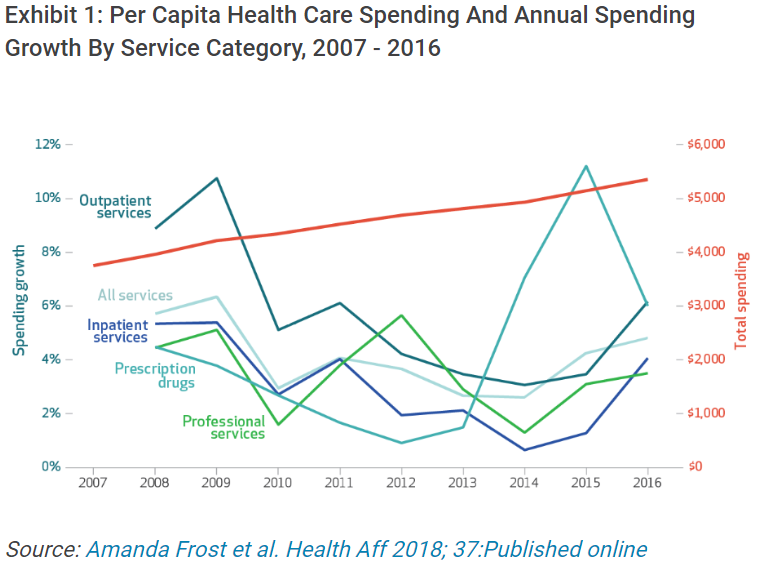 Read more: Health Affairs: Health Care Spending Under Employer-Sponsored Insurance: A 10-Year Retrospective
ABSTRACT Using a national sample of health care claims data from the Health Care Cost Institute, we found that total spending per capita (not including premiums) on health services for enrollees in employer-sponsored insurance plans increased by 44 percent from 2007 through 2016 (average annual growth of 4.1 percent). Spending increased across all major categories…
-
Health Affairs: Health Spending Growth Is Accelerating; Prices Are In The Driver’s Seat
Read more: Health Affairs: Health Spending Growth Is Accelerating; Prices Are In The Driver’s SeatHEALTH AFFAIRS BLOG: “Perhaps nothing illustrates the intractability of America’s struggle with health spending more than the recent announcement by Amazon, JP Morgan, and Berkshire Hathaway that they were founding a new entity to address health care costs for their employees. Despite lacking any concrete details this announcement managed to wipe billions of dollars in…
-
Health Affairs: Understanding Health Spending – Lessons From The Healthy Marketplace Index
Read more: Health Affairs: Understanding Health Spending – Lessons From The Healthy Marketplace IndexHEALTH AFFAIRS BLOG: “As policymakers consider actions to address challenges with the Affordable Care Act and ongoing growth in health spending, the importance of understanding local health care market dynamics is more important than ever. Traditionally, policy makers and other stakeholders have evaluated commercial health care markets’ total spending and often attributed high spending to…
-
Health Affairs: Rising Use Of Observation Care Among The Commercially Insured May Lead to Total And Out-Of-Pocket Cost Savings
Tags: Commercially Insured, Health Affairs, Inpatient Spending, Observation Stays, Out-of-Pocket, Peer Reviewed JournalsRead more: Health Affairs: Rising Use Of Observation Care Among The Commercially Insured May Lead to Total And Out-Of-Pocket Cost SavingsABSTRACT: Proponents of hospital-based observation care argue that it has the potential to reduce health care spending and lengths-of-stay, compared to short-stay inpatient hospitalizations. However, critics have raised concerns about the out-of-pocket spending associated with observation care. Recent reports of high out-of-pocket spending among Medicare beneficiaries have received considerable media attention and have prompted direct policy…
-
Health Affairs: Effects Of State Insurance Mandates On Health Care Use And Spending For Autism Spectrum Disorder
 Read more: Health Affairs: Effects Of State Insurance Mandates On Health Care Use And Spending For Autism Spectrum Disorder
ABSTRACT: Forty-six states and the District of Columbia have enacted insurance mandates that require commercial insurers to cover treatment for children with autism spectrum disorder (ASD). This study examined whether implementing autism mandates altered service use or spending among commercially insured children with ASD. We compared children age twenty-one or younger who were eligible for mandates…