
External Research
-
Health Affairs: Insurer Market Power Lowers Prices In Numerous Concentrated Provider Markets
Tags: Health Affairs, Inpatient Spending, Market Concentration, Outpatient Spending, Peer Reviewed Journals Read more: Health Affairs: Insurer Market Power Lowers Prices In Numerous Concentrated Provider Markets
ABSTRACT: Using prices of hospital admissions and visits to five types of physicians, we analyzed how provider and insurer market concentration—as measured by the Herfindahl-Hirschman Index (HHI)—interact and are correlated with prices. We found evidence that in the range of the Department of Justice’s and Federal Trade Commission’s definition of a moderately concentrated market (HHI of…
-
NBER: Does Multispecialty Practice Enhance Physician Market Power?
Read more: NBER: Does Multispecialty Practice Enhance Physician Market Power?ABSTRACT: In markets for health services, vertical integration – common ownership of producers of complementary services – may have both pro- and anti-competitive effects. Despite this, no empirical research has examined the consequences of multispecialty physician practice – a common and increasing form of vertical integration – for physician prices. We use data on 40 million…
-
Women’s Health Issues: Maternal Medical Complexity Impact on Prenatal Health Care Spending among Women at Low Risk for Cesarean Section
Tags: Commercially Insured, Inpatient Spending, Maternal Health, Outpatient Spending, Peer Reviewed Journals Read more: Women’s Health Issues: Maternal Medical Complexity Impact on Prenatal Health Care Spending among Women at Low Risk for Cesarean Section
ABSTRACT Background: Obstetric procedures are among the most expensive health care services, yet relatively little is known about health care spending among pregnant women, particularly the commercially-insured. Objective: The objective of this study was to examine the association between maternal medical complexity, as a result of having one or more comorbid conditions, and health care…
-
Psychiatric Services: Telehealth Delivery of Mental Health Services: An Analysis of Private Insurance Claims Data in the United States
Read more: Psychiatric Services: Telehealth Delivery of Mental Health Services: An Analysis of Private Insurance Claims Data in the United StatesABSTRACT: Objective: This study characterizes telehealth claims for mental health and substance abuse (MH/SA) services by using national private claims data. Methods: Telehealth-related mental health service claims were identified with private claims data from 2009 to 2013. These data—provided by the Health Care Cost Institute—included claims from Aetna, Humana, and UnitedHealth for more than 50 million individuals…
-
Academic Emergency Medicine: Association Between Maternal Comorbidities and Emergency Department Use Among a National Sample of Commercially Insured Pregnant Women
 Read more: Academic Emergency Medicine: Association Between Maternal Comorbidities and Emergency Department Use Among a National Sample of Commercially Insured Pregnant Women
ABSTRACT Objectives: Evidence suggests that, despite routine engagement with the health system, pregnant women commonly seek emergency care. The objectives of this study were to examine the association between maternal comorbidities and emergency department (ED) use among a national sample of commercially insured pregnant women. Methods: We conducted a retrospective cohort study using multipayer medical…
-
Congressional Budget Office Working Paper Series: An Analysis of Private-Sector Prices for Hospital Admissions
Tags: CBO, Commercially Insured, Geographic Variation, Inpatient Spending, Medicare, Medicare Advantage, Outpatient Spending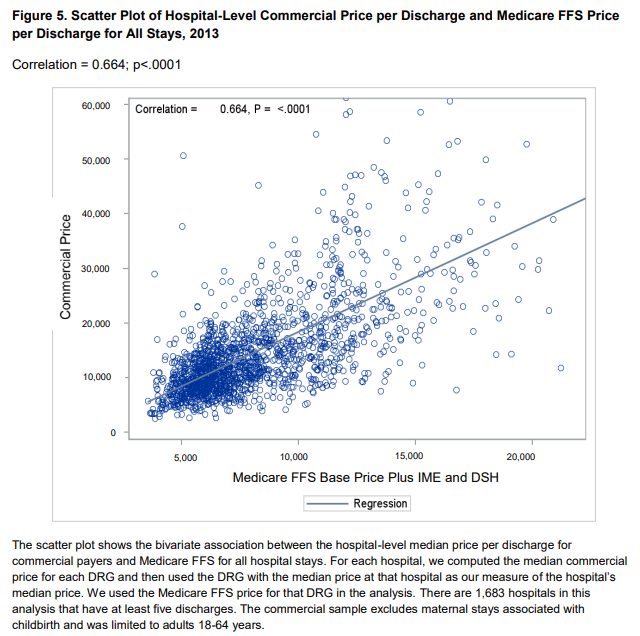 Read more: Congressional Budget Office Working Paper Series: An Analysis of Private-Sector Prices for Hospital Admissions
ABSTRACT: Prices for hospital admissions have received considerable attention in recent years, both because they are an important component of health care spending and because they can vary widely. In this paper, we use 2013 claims data from three large insurers to examine the hospital payment rates of those insurers in their commercial plans and…
-
Health Affairs: Reference Pricing Changes the ‘Choice Architecture’ of Health Care for Consumers
Read more: Health Affairs: Reference Pricing Changes the ‘Choice Architecture’ of Health Care for ConsumersABSTRACT: Reference pricing in health insurance creates incentives for patients to select for nonemergency services providers that charge relatively low prices and still offer high quality of care. It changes the “choice architecture” by offering standard coverage if the patient chooses cost-effective providers but requires considerable consumer cost sharing if more expensive alternatives are selected….
-
Health Services Research: Payer Type and Low‐Value Care: Comparing Choosing Wisely Services across Commercial and Medicare Populations
Read more: Health Services Research: Payer Type and Low‐Value Care: Comparing Choosing Wisely Services across Commercial and Medicare PopulationsABSTRACT Objective: To compare low‐value health service use among commercially insured and Medicare populations and explore the influence of payer type on the provision of low‐value care. Data Sources: 2009–2011 national Medicare and commercial insurance administrative data. Design: We created claims‐based algorithms to measure seven Choosing Wisely‐identified low‐value services and examined the correlation between commercial…
-
NBER Working Paper: Healthcare Spending and Utilization in Public and Private Medicare
Tags: Geographic Variation, Medicare, Medicare Advantage, NBER, Peer Reviewed Journals, Value Based Care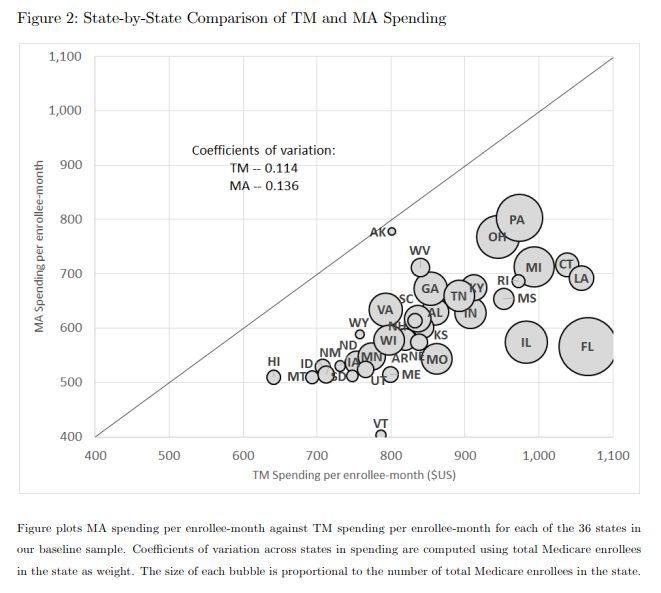 Read more: NBER Working Paper: Healthcare Spending and Utilization in Public and Private Medicare
ABSTRACT: We compare healthcare spending in public and private Medicare using newly available claims data from Medicare Advantage (MA) insurers. MA insurer revenues are 30 percent higher than their healthcare spending. Healthcare spending is 25 percent lower for MA enrollees than for enrollees in traditional Medicare (TM) in the same county with the same risk…
-
NBER: Why Don’t Commercial Health Plans Use Prospective Payment?
Tags: Commercially Insured, Geographic Variation, Inpatient Spending, Market Concentration, NBER, Peer Reviewed JournalsRead more: NBER: Why Don’t Commercial Health Plans Use Prospective Payment?ABSTRACT One of the key terms in contracts between hospitals and insurers is how the parties apportion the financial risk of treating unexpectedly costly patients. “Prospective” payment contracts give hospitals a lump-sum amount, depending on the medical condition of the patient, with limited adjustment for the level of services provided. We use data from the…